
Increasing patient volume by building brand starts with a metric problem: footfall is a blended metric that hides two different kinds of patients, and splitting it apart tells you whether growth is compounding or rented.
Two hospitals can report the identical footfall number this month and be in completely different positions. One hospital’s new patients are people a discount package or a health camp brought in for a single visit. The other’s are patients a referring doctor sent, already expecting them to stay. The monthly footfall count doesn’t know the difference — it just adds both groups together and calls the total “growth.”
This is why footfall-chasing tactics can look like they’re working right up until they stop. A camp or an ad campaign moves the number this month. It says nothing about whether next month’s number depends on running the same campaign again, or whether it’s now self-sustaining. Most operators only find out which one they built after the spend stops and the number falls back — or doesn’t.
The fix isn’t a better tactic. It’s knowing, before the next rupee is spent, which of the two patient populations last quarter’s “growth” actually was.
Why can’t footfall alone tell you what’s actually growing?
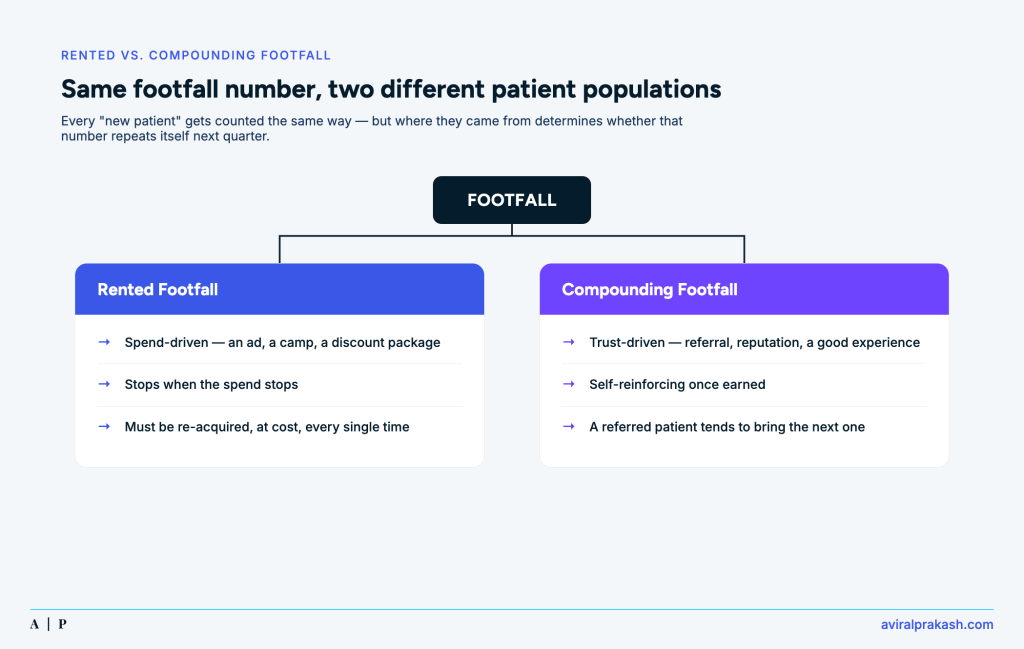
Direct answer: Footfall is a single number that blends two populations with opposite economics, so a rising footfall count can mean a hospital is either building a durable patient base or spending to replace the same one-time visitors every month.
- Call the first population rented footfall: acquired via spend, present for exactly as long as the spend continues, gone once it stops.
- Call the second compounding footfall: acquired via trust — referral, reputation, a good experience patients talk about — present because the hospital earned it, and self-reinforcing, because a compounding patient often brings the next one.
A hospital chasing footfall as one number can grow rented footfall for years without ever noticing compounding footfall isn’t happening, because the top-line count goes up either way. Only the split reveals which situation an operator is actually in.
Why is this distinction so easy to miss?
Direct answer: Most hospital registration systems — including the MIS (management information system, the software running patient records and billing) — log “new patient” as a single field, with no record of why the patient came or who sent them — so a spike from a paid campaign and a rise in doctor referrals look identical in the monthly report.
The piece on hospital branding strategy traces one version of this: a Jalandhar hospital that spent ₹3.5 lakh on ads only discovered the campaign hadn’t built anything when OPD (outpatient department) walk-ins fell back to baseline the moment the spend stopped — by then, the money was already gone. And the piece on patient psychology traces a second version through occupancy rather than footfall: a Rajkot hospital’s new-inquiry count rose after ₹12 lakh in ads, but repeat visits didn’t move, while a competitor with no ad spend at all ran at 85% occupancy against its 62%.
Both operators eventually found the gap between rented and compounding growth. Neither had a number that would have shown it to them in advance — which is a patient acquisition strategy problem as much as a marketing one: you cannot manage what your intake data doesn’t distinguish.
How to increase patient volume by building brand, not renting it
Direct answer: First calculate three numbers — repeat-visit rate, referral share of new patients, and source-of-patient mix — split a single footfall count into rented and compounding growth, using data most Indian hospitals already capture at registration.
Repeat-visit rate
- What it measures: The share of this period’s visits that come from patients who have visited before, as a percentage of total visits.
- How to calculate it: Most billing or MIS software already tags returning patients by phone number or patient ID. Where it doesn’t, a manual pull of the last quarter’s registration records by phone number will approximate it closely enough to start.
- What it tells you: A period where footfall rose but repeat-visit rate stayed flat or fell means the growth was rented — new patients arrived, but no one who was already a patient came back more often. This is important because acquiring new customers is several times more expensive than getting existing one’s to maintain loyalty and increase spend.
Referral share of new patients
- What it measures: The percentage of new patients this period who arrived because a doctor, an existing patient, or a family member sent them, as opposed to a walk-in, an ad, or an aggregator listing.
- How to calculate it: Most front desks already ask “how did you hear about us” at registration but don’t tabulate the answers. Tabulating even one month of this field is enough to establish a baseline.
- What it tells you: A low referral share alongside rising footfall means the hospital is buying most of its growth rather than earning it.
Source-of-patient mix
- What it measures: New patients broken down by acquisition channel — referral, organic walk-in, paid ad, aggregator listing, camp or discount package.
- How to calculate it: The same registration-intake field as above, tabulated by channel instead of a simple referred: yes/no.
- What it tells you: This is the number that tells you where to intervene, not just whether there’s a problem.
| Metric | Rented-footfall signal | Compounding-footfall signal |
|---|---|---|
| Repeat-visit rate | Flat or falling while footfall rises | Rising alongside footfall |
| Referral share | Low, most new patients unreferred | High, growing without added spend |
| Source-of-patient mix | Dominated by paid ads, camps, aggregators | Dominated by referral and organic |

What do your numbers tell you to do next?
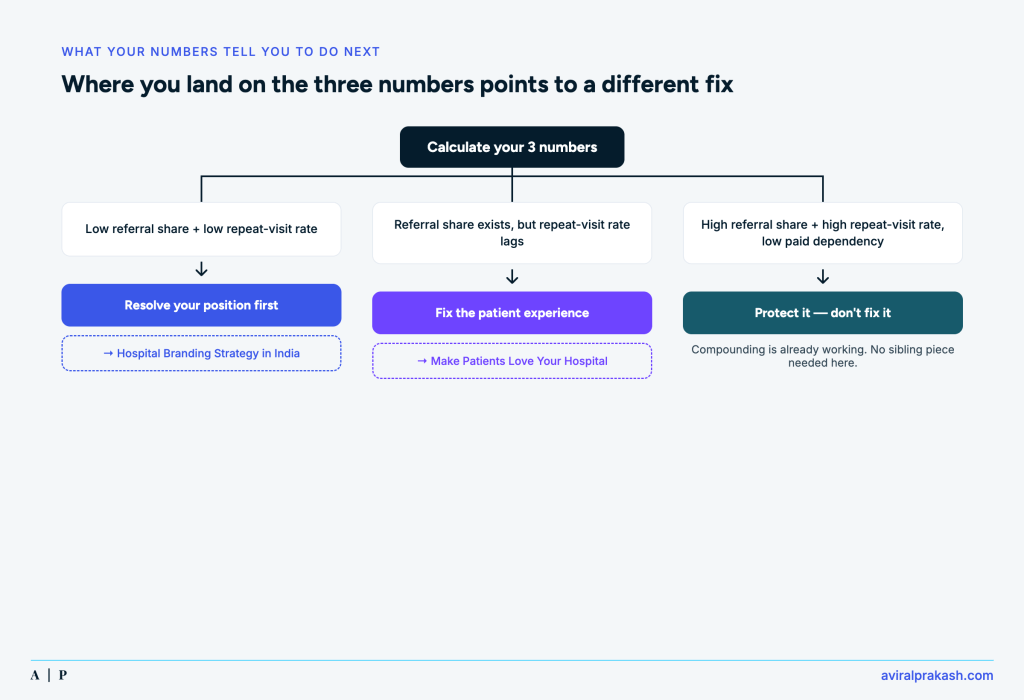
Direct answer: Where a hospital lands on these three numbers points to one of two different fixes — and sometimes to no fix at all.
- Paid/camp/aggregator channels dominate, and referral share is low. There isn’t yet a resolved brand position worth repeating OR advertising is amplifying a claim that patients do not believe yet. This is the problem A|P’s hospital branding strategy piece addresses: resolve who the hospital is for, and who it explicitly isn’t for, before spending again.
- Referral share exists, but repeat-visit rate still lags. The acquisition is working; the leak is what happens after a patient arrives. This is the problem A|P’s patient psychology piece addresses: the discharge conversation, the first ten minutes, the follow-up call — the design of the experience itself.
- High referral share, high repeat-visit rate, low paid dependency. Compounding is already working. The job is protecting it — not fixing it, and not necessarily spending more to accelerate it.
While there isn’t yet a rigorous, India-specific study quantifying exactly how much cheaper compounding footfall is than rented footfall — the directional logic holds regardless: a referred patient costs a hospital close to nothing to acquire and needs no repeat spend to return, while a rented patient has to be re-acquired, at cost, every single time.
Frequently asked questions
What if my hospital doesn’t currently track referral source?
Start now, even manually. Add a mandatory “how did you hear about us” field at registration, and tabulate it by hand each month if the MIS can’t automate it yet. A single quarter of data is enough to see whether referral share is rising or falling.
How often should these three numbers be recalculated?
Quarterly is frequent enough to catch a shift under normal conditions. Recalculate monthly while running any paid campaign, so it’s possible to tell early whether the spend is producing compounding patients or just rented ones.
Is footfall a useless number, then?
No — footfall still matters for capacity planning and short-term revenue. It’s incomplete, not useless. On its own, it just can’t say whether this quarter’s growth will still be there next quarter without repeating the same spend.
The number worth checking before the next campaign
The question isn’t whether to chase footfall or build brand — every hospital needs footfall to survive the current quarter. The question is whether an operator can currently tell, from their own numbers, which of this quarter’s new patients are rented and which are compounding. Most can’t yet. That gap is worth closing before the next marketing rupee is spent, because a hospital that can’t see the split can’t tell whether its last campaign built something or just rented attention for a month.
This piece is part of A|P’s growth strategy guide for private clinics and hospitals in India.
Leave a Reply